
ROB RUN Map Guide: Districts, Settlements & Loot Spots
How the ROB RUN map works: the global map, district levels, settlement ownership, Looty Bay loot spots, the desert and the prison, and how to plan a route.
Quick answer. ROB RUN uses one shared global map divided into districts, and each district contains settlements. You can only rent a plot in a settlement that already has an owner. Looty Bay is the crime city, the desert is the high-risk travel space, and the prison is the server-transfer hub.
- The map is shared by every player on the server.
- Districts have levels that determine what you can buy there.
- Settlements must have owners before plots can be rented.
- District and settlement owners take a cut of the money moving through them.
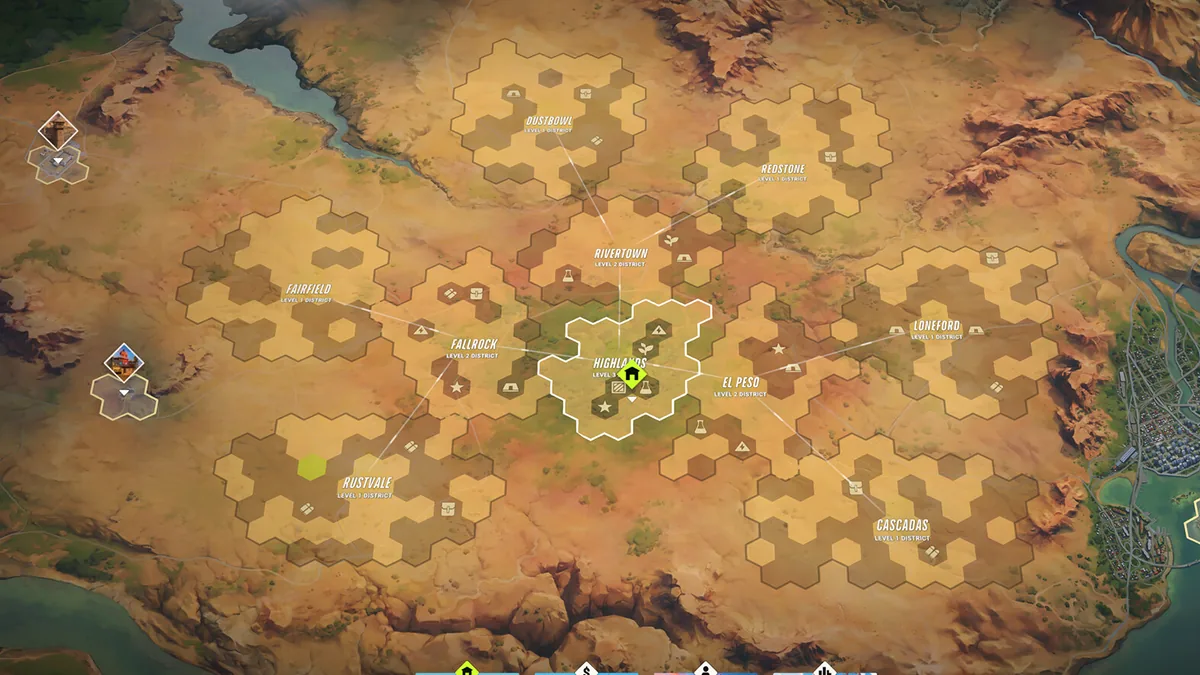
Pick a home district, learn its parking, bank and exits, then expand.
The three map layers
ROB RUN is not one open world. It is three connected spaces with different rules:
| Space | What happens there | Death rule |
|---|---|---|
| Looty Bay | Heists, shops, banks, police, player bases | Criminals lose inventory; civilians keep bag and gear |
| The desert | Travel, cargo runs, open-world encounters | All loot is lost on death |
| The prison | Server transfer and jail time | No loot loop; used to move between servers |
The desert is the one that surprises people. It looks like open world, but the death penalty is harsher than in the city. If you are carrying a full bag, the city is safer than the sand.
Districts and settlements
The ownership chain explains almost every map question:
- The global map is divided into districts.
- Each district contains multiple settlements.
- Each settlement contains plots.
- Plots can only be rented when the settlement has an owner.
- District level controls what can be bought there; level 2 and level 3 plots require special documents from the Black Market.
That is why "find an empty spot and build" does not work. Empty land is either unowned or owned by someone who has not opened it for tenants. The power pyramid page→ explains who collects what at each level.
What district level changes
Higher-level districts gate better services and require paperwork. The practical effects:
- Level 1 is where most players rent their first plot. It is cheaper and less contested.
- Level 2 and 3 require special documents from the Black Market before you can rent.
- Central districts are the only places where certain purchases, such as a helicopter for your base, are available.
Do not assume the highest-level district is the best. A level 3 plot costs more, attracts more attention and requires capital you may not have. A quiet level 1 base with a workbench and storage is a better first move.
Looty Bay: what is where
The city is organised by function, not by a single loot street. The tracked location list includes:
- Retail: Convenience Stores, Electronics Stores, Gun Shops, Jewelry Stores, Equipment Stores, a Pharmacy and a Gas Station.
- Targets: Looty Bay Bank, the Police Station, the Art Gallery, the Grand Hotel and the Strip Club.
- Services: Lenny's Motel, Parking Terminals, the Hospital, cafés and hotels.
- Property: Land Plots, Plot Plans, player bases and the Bunker.
- High-end: Noble's Mansion, the Reef Hotel, Elite Cottages and the Hangar.
The locations page→ groups them by what they are worth to a heist. The map marks a fence van with a dollar sign, and Sales Centers handle bulk cargo.
Planning a route
A route is not a straight line between two points. It is a sequence with a bail-out:
- Start at your base or the default spawn.
- Scout the target unmasked.
- Hit the target and fill one bag.
- Exit toward the fence, not toward another target.
- Bail if the street fills with police or players.
The map matters most at step four. If the fence is on the other side of a police station, the route is wrong regardless of how good the target was.
Getting around
Vehicles change the map more than any other purchase. If you have no active vehicle, you can rent one free at the nearest Parking Terminal. That makes a distant target viable and a quick exit possible.
Owned vehicles require a plot with a house or garage. You can buy a vehicle once you have the property, store the key in a key locker, and install modules under the hood, trunk and underbody. The vehicles page→ covers the tracked models and speeds.
Helicopters are a separate tier: you can only buy one if your base is in a central district, though they can also be found in loot.
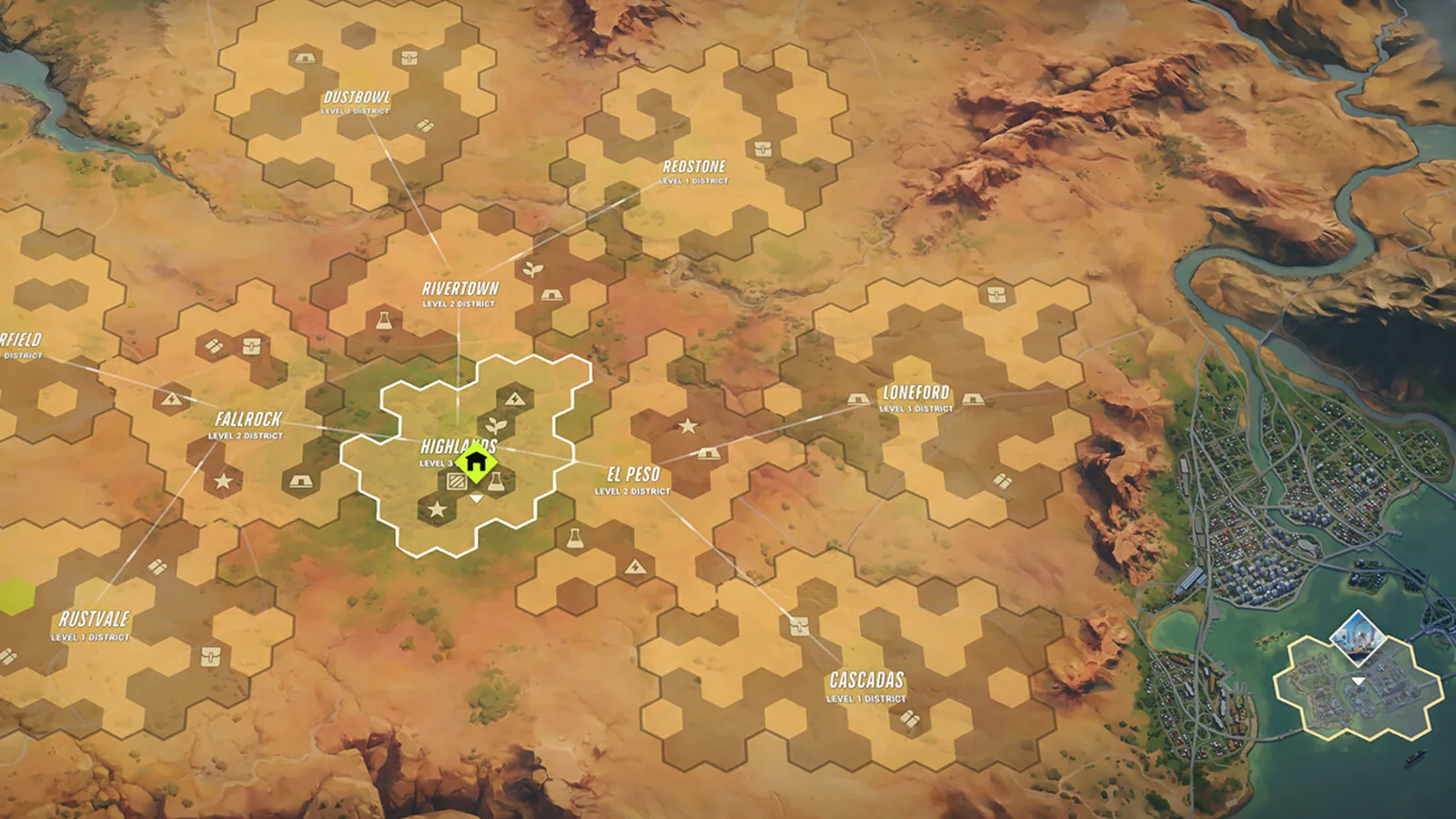
Reading the map like a criminal
Three habits separate a good route from a lucky one:
- Count exits, not entrances. The door you enter through is rarely the door you leave through.
- Know where the fence is before the mask. The dollar-sign van is the end of the route.
- Watch the district, not just the street. A quiet street next to a police station is not quiet.
The heist guide→ applies this to target selection, and the notoriety page→ explains why the map gets more dangerous the longer you stay active.
FAQ
Is the ROB RUN map shared between players?
Yes. The global map is shared by everyone on the server, including player bases and settlement ownership.
How do I rent a plot?
Find a settlement with an owner and a vacant plot, then pay at the sign next to it. Level 2 and 3 districts require special documents from the Black Market.
What is the desert for?
Travel and cargo runs. The death penalty there is harsher: you lose all loot, not just the bag.
Can I change servers?
Yes. Use the global map to reach the Prison, surrender to the Feds, then switch to a friend's server from inside the prison and resend the invite.
Official source: Kefir Help Center, ROB RUN Steam store page and Steam announcements (checked 2026-11-06).
Sources
- Kefir Help Center — Global map and settlements ↗ — district and plot rules.
- ROB RUN Steam store page ↗ — official feature list.
- ROB RUN Steam announcements ↗ — map and wipe changes.